How to Migrate from Selenium to Playwright Without Rebuilding Your Debt
Most Selenium-to-Playwright migrations fail due to legacy patterns. Learn a POC framework, fixture setup, and testing integration that work.
Most Selenium-to-Playwright migrations fail due to legacy patterns. Learn a POC framework, fixture setup, and testing integration that work.
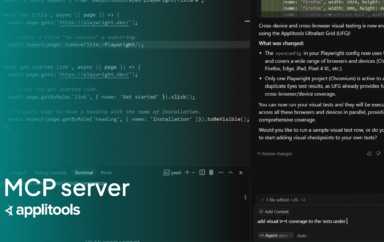
The Agentic SDLC shifts the bottleneck from code production to verification. Learn how Applitools provides a deterministic quality gate with Eyes MCP and Autonomous Troubleshooting to fix the “flakiness loop” and reduce test maintenance costs.
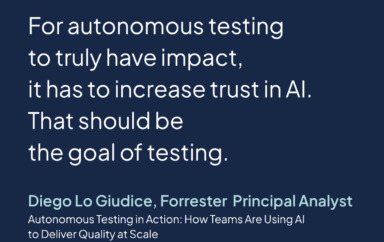
AI is reshaping the software development lifecycle into a connected, agent-driven system. As development accelerates, testing is evolving alongside it—becoming more integrated, continuous, and essential to maintaining quality at scale.
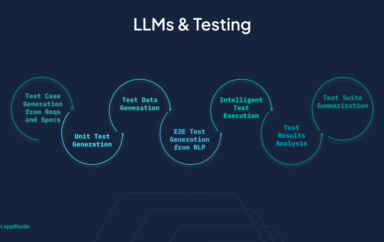
Generative AI excels at creating tests—but execution demands repeatability and trust. Learn why deterministic approaches matter for reliable test automation.
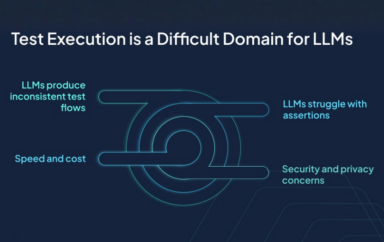
AI is reshaping software testing—but more AI often means more noise. Learn how engineering leaders can build trust, reduce flakiness, and scale test automation.

Reduce flakiness, speed up reviews, and see how teams like Peloton cut maintenance time by 78% using Visual AI.
Testing moves fast. See how teams use code and no-code speed runs to scale coverage, reduce maintenance, and deliver faster feedback with AI.

The future of test automation isn’t about choosing code or no-code—it’s about combining both. Learn how this balanced approach reduces bottlenecks, speeds regression testing, and empowers QA teams to scale quality with confidence.

Discover why the strongest test automation strategies don’t pit code against no-code. Learn how integrating both approaches reduces bottlenecks, speeds up regression testing, and empowers teams to deliver quality software faster.
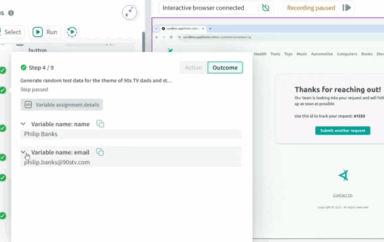
The newest updates to Applitools Autonomous and Eyes introduce AI-assisted test creation, built-in API and data support, and previews of upcoming MCP and mobile features.
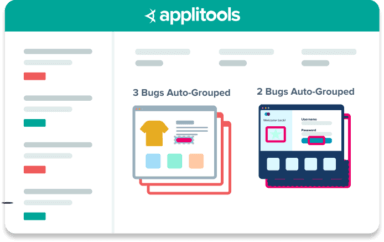
Learn how teams are slashing test maintenance by up to 75% using self-healing automation, no-code authoring, and intelligent test grouping—plus a real-world case study from Peloton.
Even with 100% code coverage, critical bugs still slip through. In this post, we explore five common gaps in software test coverage—from missed visual defects to untested browser variations—and how modern teams are using visual AI and no-code test automation to close them.