
Software engineering is undergoing its most profound structural shift since the cloud: the move to the Agentic Software Development Lifecycle (SDLC).
AI coding agents like Claude Code, Cursor, GitHub Copilot, and Cline are no longer simple autocomplete tools. They act as autonomous co-pilots, drafting full front-end components, refactoring UI architectures, and committing code at 10x velocity.
However, as software development accelerates exponentially, a new critical risk has emerged across modern engineering organizations: How do you validate UI code when generation happens faster than human verification?
When teams adopt AI coding agents, they quickly run into an anti-pattern we call the Probabilistic Validation Gap.
When an AI agent writes UI code, developers naturally try to validate it by passing screenshots back to vision language or by relying on traditional, fragile automated test scripts. This creates two immediate breakdowns:
Engineering leaders are left trapped: code velocity accelerates by 10x, but release confidence plummets because no objective, reproducible quality signal exists to verify what the AI agent built.
To deploy AI-generated code with complete visual confidence, modern development pipelines require an objective, deterministic governance layer.
Today, Applitools is launching a breakthrough platform release designed specifically to bridge the Probabilistic Validation Gap. By combining our proprietary Deterministic Language Model (DLM) with Visual AI trained on billions of images, Applitools provides zero-variance, reproducible visual quality directly inside developer workflows.
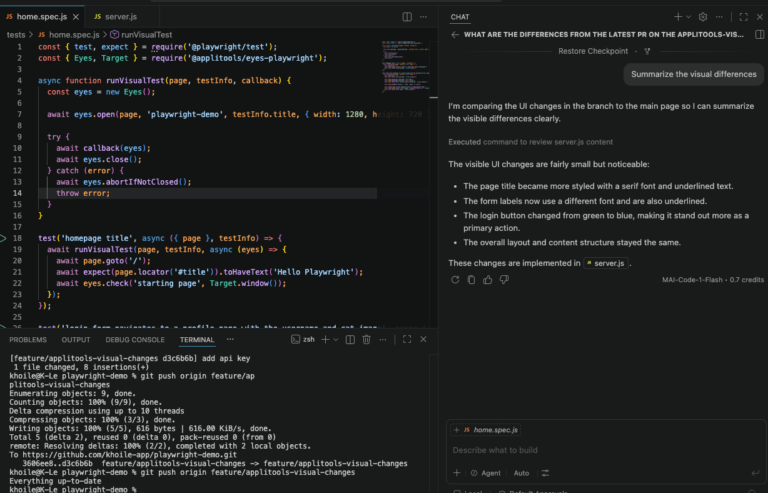
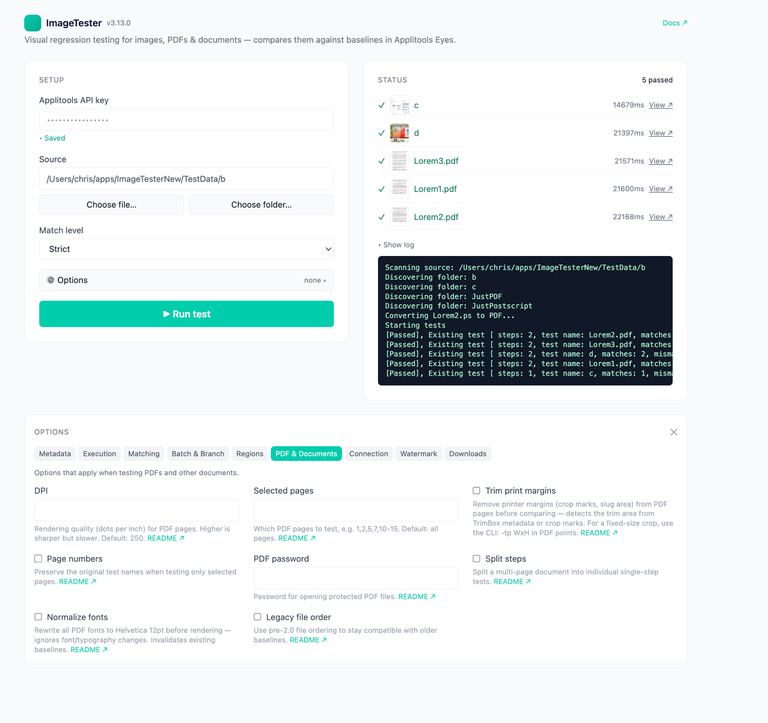
We are bringing Visual AI directly into developer AI coding agents. Connected via the Model Context Protocol (MCP), agents using Claude Code, Cursor, Copilot, or Cline become proactive visual QA partners. Agents autonomously fetch pixel-exact diff bounding boxes, inspect pruned DOM context, trace layout bugs back to exact source lines, and resolve baselines—all within the developer’s chat prompt.
Figure 1: Developers prompt their AI agent to investigate visual diffs and resolve baselines natively inside their IDE.
📖 Read the Eyes MCP Overview & Setup Guide
Design systems live in Figma, but enforcing design fidelity in live code historically required tedious manual reviews or brittle custom scripts. With our native SDK integration, developers can map live tests directly to Figma design URLs. Applitools automatically sizes viewports to match design frame specs and enforces Visual AI matching (Strict, Layout, Content) against live running code, completely eliminating false positives from zoom mismatches and sub-pixel rendering.
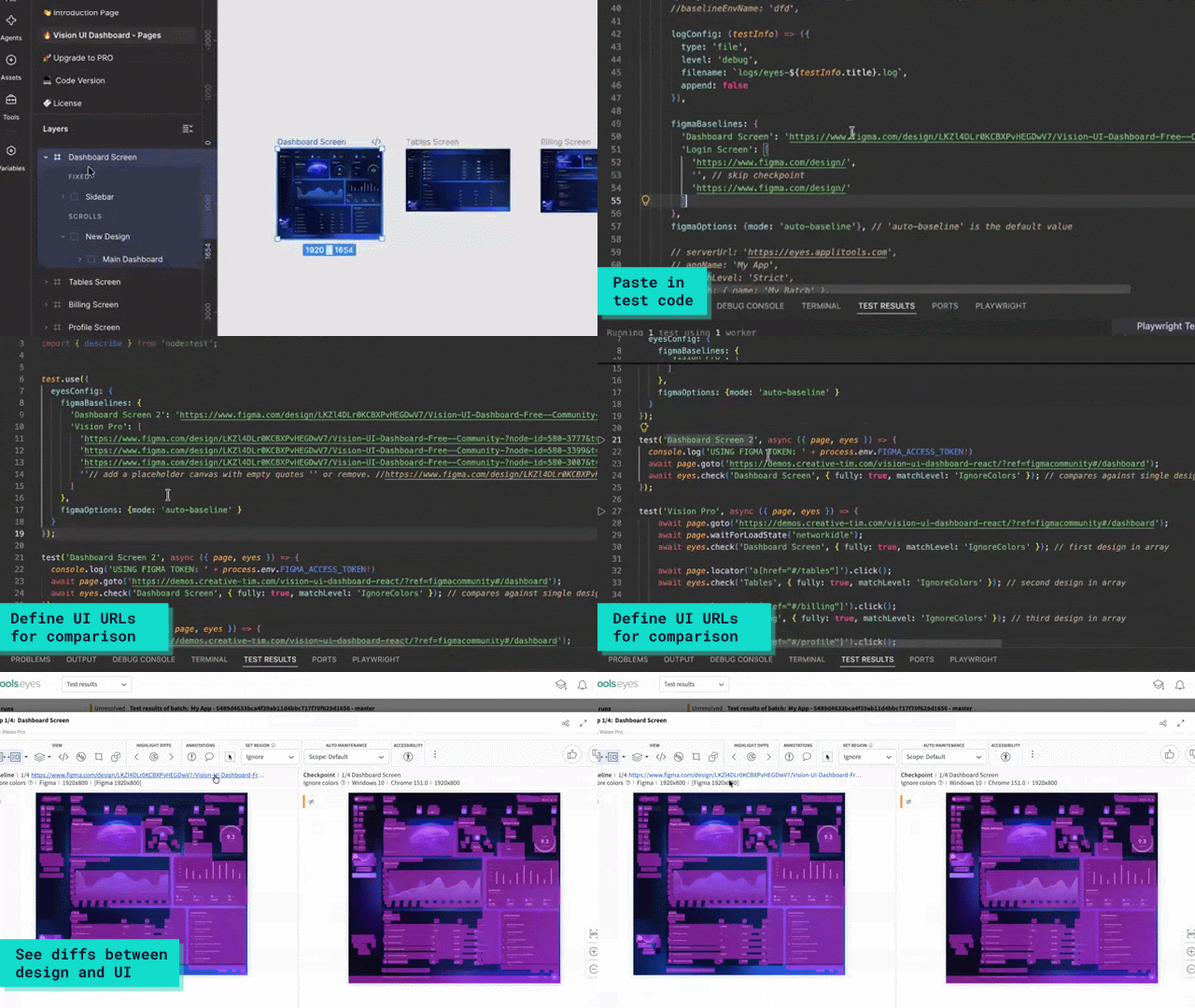
Figure 2: Automated vector-to-DOM matching between Figma design frames and live rendered web apps.
📖 Explore Figma Design Baseline SDK Docs
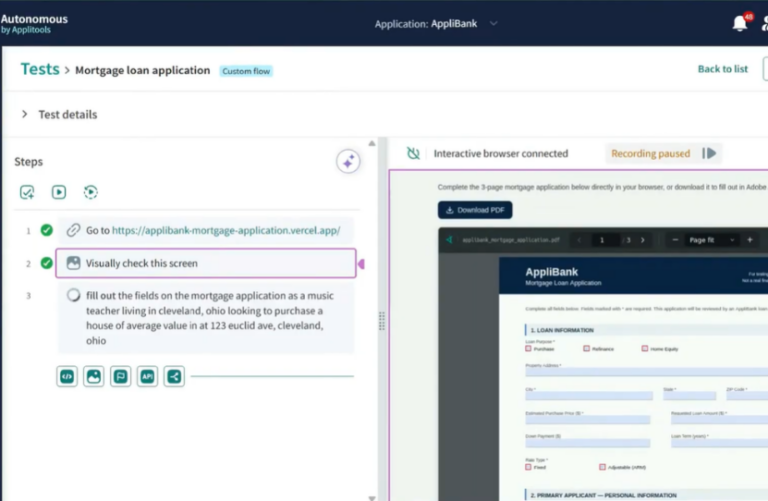
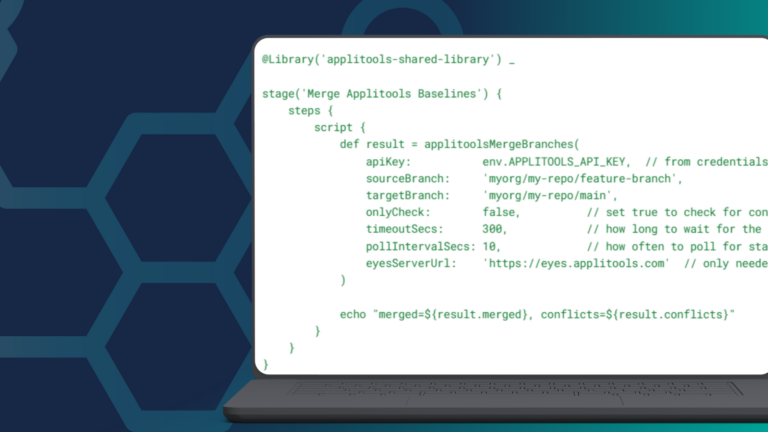
We are eliminating the locator maintenance tax by enabling developers to write resilient UI automation in plain English inside Playwright test suites. Powered by a secure, proprietary in-house engine, tests self-heal against structural DOM updates without exposing corporate code or user data to public LLM models.
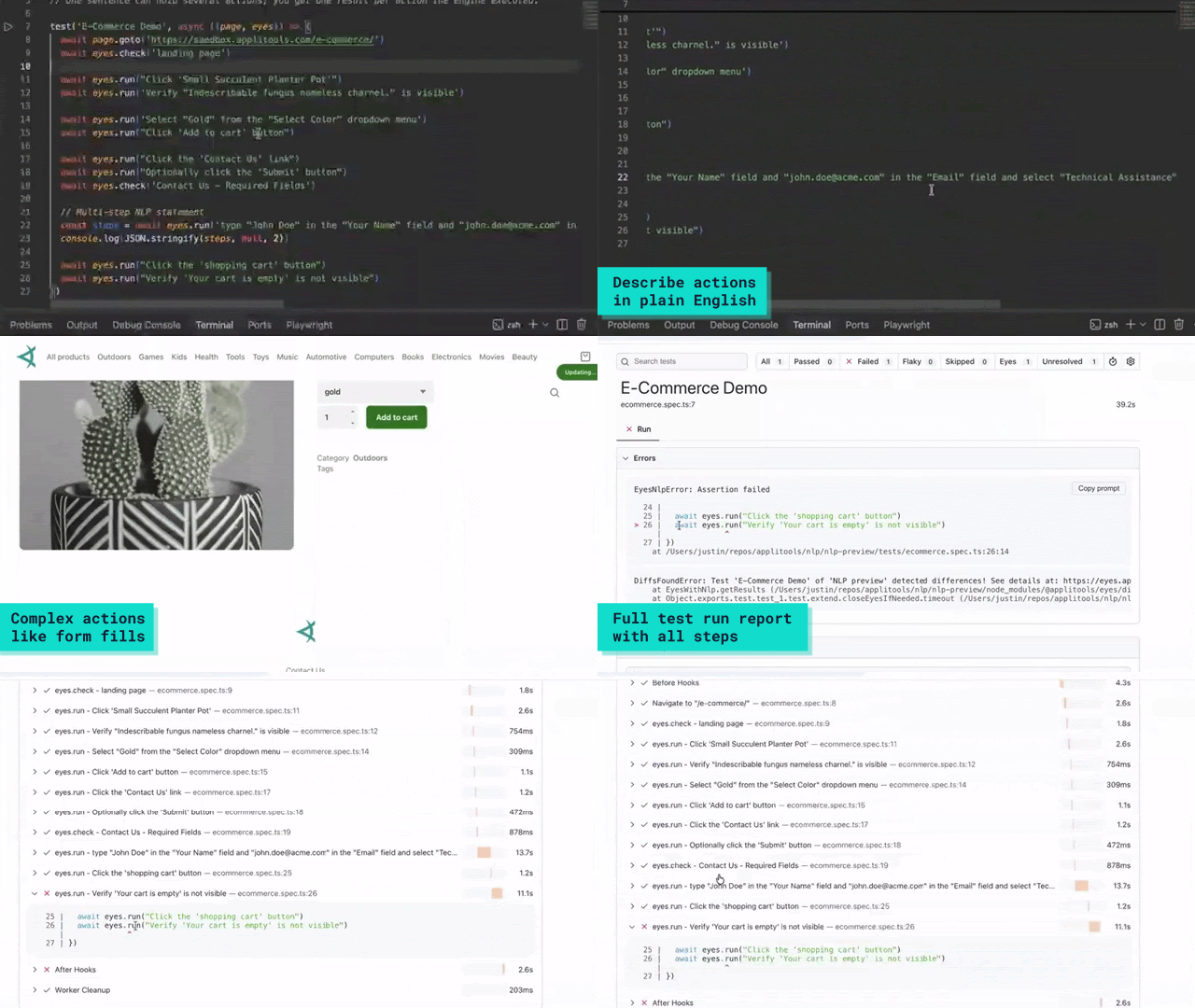
Figure 3: Plain-English test steps (eyes.run) combined with Visual AI checkpoints in a single Playwright script.
📖 Learn About NLP Test Steps for Playwright
Engineering organizations using Applitools as their deterministic guardrail achieve immediate operational scale:
| Strategic Area | Legacy / Probabilistic Approach | Applitools Deterministic Governance | Enterprise Impact |
| AI Agent Validation | Generic VLMs inspect raw screenshots; high token costs and visual hallucinations incur. | Eyes MCP Tools: Visual AI handles pixel diffs; LLM correlates pruned DOM directly to code lines. | Zero Context Switching: Agent chat diff investigation and baseline updates via natural language. |
| Design System Auditing | Manual pixel checking or ad-hoc PNG export scripts that break on viewport mismatches. | Figma Design Baselines: Direct Figma API resolution, auto-viewport sizing, vector-to-DOM matching. | Single Source of Truth: Automated design fidelity checks in CI pipelines without false positives. |
| Test Suite Maintenance | Brittle CSS/XPath selectors break on every UI refactor, consuming 50% of sprint time. | NLP Test Steps for SDKs: Plain-English commands backed by Visual AI and a secure, local engine. | 80% Lower Maintenance Tax: Self-healing tests immune to DOM structural shifts. |
Don’t let probabilistic AI validate your AI-generated code. With Applitools, engineering teams gain the speed of generative development paired with the absolute certainty of deterministic governance.
📅 Request a Demo: Experience live agentic visual governance