When testing needs to keep up with faster releases and growing complexity, the challenge isn’t just what to automate—it’s how fast you can create and validate reliable tests.
Code and no-code testing now work together to accelerate test creation, expand coverage, and deliver faster feedback across browsers and devices. By combining AI-assisted test creation with visual validation, you can go from setup to scale in hours instead of weeks.
A Smarter Way to Split Your Effort
High-performing teams balance two types of coverage:
- 20% custom flow tests: Focused, AI-assisted checks for your most critical user journeys
- 80% visual coverage: Full-page validation across browsers and devices with Visual AI
This approach ensures your key flows are verified with precision while everything else is continuously validated for layout, content, and visual consistency.
Full-Site Testing in Minutes
With Autonomous testing, you can point to any URL—or even a subfolder—and let AI do the rest. It crawls your sitemap, creates baselines, and runs cross-browser and cross-device tests automatically.
Setup takes minutes. You can schedule recurring tests daily or weekly, and catch both visual regressions and new pages as they appear.
During one large-scale migration, this approach tested more than 1,500 pages across five browsers and devices. Visual AI caught thousands of small layout changes, grouped them by pattern, and reduced the workload to just 10 unique issues after a single fix acceptance.
Depth Where It Matters
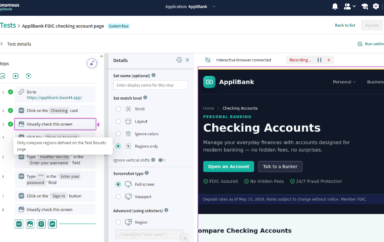
For the 20% that need fine-grained control, AI-assisted test authoring speeds up creation. You can describe each action in plain English—“add item to cart,” “verify success message,” or “fill out this form”—and the system turns those steps into repeatable tests.
AI assists by:
- Generating realistic test data
- Creating textual and visual assertions
- Masking sensitive fields automatically
The result: fast, accurate flows that non-coders and engineers can both maintain.
Reliable Execution, Every Time
Applitools’ deterministic LLM executes steps based on visual descriptions, not fragile locators or XPath. That means if a class name or element ID changes, the test still runs correctly.
It also eliminates token costs and flaky reruns common with external LLM agents, since all logic runs natively inside the platform.
Data Validation Included
End-to-end validation doesn’t stop at the UI. Within the same test, you can call APIs, capture responses, and assert that backend data matches what appears on screen.
Visual results, API responses, and data integrity checks all happen within a single low-code environment.
Reuse More, Maintain Less
Reusable test flows—like login, cleanup, or environment switching—save time and cut duplication. You can parameterize roles or URLs, then reuse those flows across staging, integration, and production.
That modular structure lets QA, developers, and product teams collaborate without reinventing the same tests for each environment.
The Fast Track to Full Coverage
By combining AI-assisted test creation with Visual AI validation, teams achieve:
- Broader coverage with less maintenance
- Faster release confidence
- Consistent, human-readable results
Whether you write code daily or prefer a visual test builder, this blended approach keeps quality high and bottlenecks low.
Try It Yourself
See how AI-assisted testing speeds up coverage for your own apps with Applitools Autonomous, or explore how Visual AI helps teams validate every page and device in minutes.