
Today’s software applications are getting more complicated, thus every testing team needs to focus on expanding test coverage. To achieve this goal, it is important to use a combination of testing types, such as unit testing, integration testing, system testing, and end-to-end testing, depending on the software application’s complexity and requirements.
End-to-End (E2E) testing is designed to ensure that all components of a software application are working together correctly and that the system as a whole meets the desired functionality, performance, and reliability requirements.
Cypress is a popular open-source end-to-end testing framework for web applications. It is designed to make the testing process easier and more efficient for developers. One of the unique features of Cypress is that it runs the tests within the browser, which means that it can provide better control and visibility over the application under test.
In this blog on End to End testing, we will deep dive into performing Cypress End to End testing on a local Cypress grid and will explain how to start automating visual tests with Applitools Eyes and the Ultrafast Grid using Cypress in JavaScript.
End-to-end (E2E) testing is a software testing strategy that verifies an application’s complete flow from beginning to end. It is a type of functional testing that tests the application’s behavior as a complete system, rather than testing individual components in isolation.
E2E testing simulates a real user scenario and covers all aspects of the application, including user interfaces, APIs, databases, and other integrations. It typically involves testing multiple components of an application to ensure that they work together as expected and fulfill the requirements of the business or end-users.
E2E testing is typically performed after other types of testing, such as unit testing and integration testing, have been completed. It is used to validate that the entire system works together seamlessly and to identify any issues that may have been missed in earlier stages of testing.
End-to-end testing (E2E testing) is a type of software testing that tests the entire system or application from start to finish, simulating real-world user scenarios.
Unit testing alone is not enough to ensure the quality and reliability of software. While unit testing is an important part of the testing process, it only verifies the behavior of individual components or modules of the software in isolation. It does not guarantee that the software will work correctly when integrated with other components or modules.
This is where integration testing enters into the picture. Integration testing focuses on testing the interaction between two or more components of a system, to ensure that they work together correctly. However, even if all the individual components pass integration testing, there may still be issues with the overall system when all the components are put together. This is where end-to-end testing comes in – it tests the entire system from start to finish.
Cypress is a popular automation testing framework that is designed specifically for end-to-end testing. It runs tests directly in the browser, allowing it to provide an experience that is similar to how users interact with the application. This makes it easier to identify any issues that users might face, as the testing environment is as close to the real-world experience as possible.
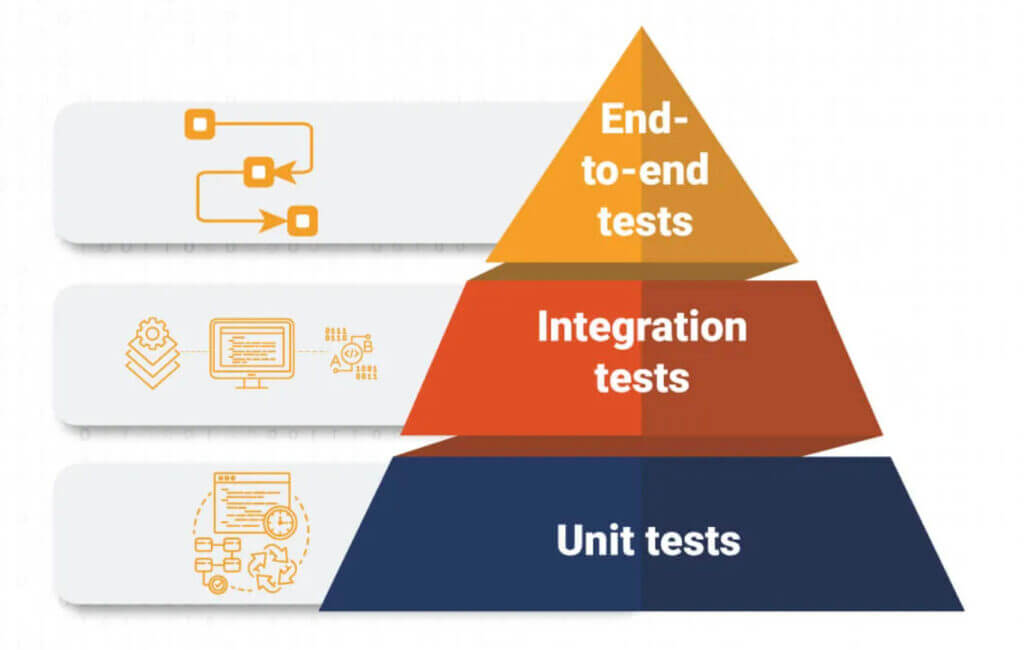
To understand End to End testing, Let’s take a closer look at Mike Cohn’s test automation pyramid. We routinely do each level of testing listed in this pyramid while running automated Cypress testing.
The automation pyramid is a popular framework introduced by Mike Cohn that helps teams to plan and prioritize their testing efforts. It includes three levels of testing, which are:
There are several benefits of End to End testing. Some of the benefits of E2E testing include:
Faster Time-to-Market: By catching defects earlier in the development process, end-to-end testing can help to reduce delays and accelerate the time-to-market of the application.
There are several popular frameworks for end-to-end testing, including:
Cypress is a JavaScript-based end-to-end testing framework that provides a simple and intuitive API for testing web applications. Cypress supports modern web development technologies like React, Angular, Vue.js, and more. It provides a built-in test runner, and it runs tests in the browser, which makes it fast and reliable.
Cypress runs tests inside the browser; it also provides detailed information about what’s happening at every step of the test, including network requests, console output, and DOM changes. This makes it easier to identify and troubleshoot issues and helps ensure that the application is working as intended.
Cypress Trends on GitHub
The following information is taken from the official website of Cypress GitHub repository:
WebdriverIO is a popular open-source testing framework for Node.js that allows developers to automate web applications in a simple and efficient way. It uses the WebDriver API to communicate with browsers and supports a variety of testing frameworks, including Mocha, Jasmine, and Cucumber.
.WebdriverIO Trends on GitHub
The following information is taken from the official website of WebdriverIO GitHub repository:
Nightwatch.js is an open-source Node.js-based end-to-end testing framework used to automate browser testing. It provides a simple and easy-to-use syntax for writing automated tests in JavaScript and allows you to run tests in real web browsers like Chrome, Firefox, and Safari.
Nightwatch.js uses the WebDriver protocol to communicate with the browser and control its behavior. It also includes a powerful built-in assertion library that makes it easy to write test assertions and helps you quickly identify issues with your web application.
Nightwatch.js Trends on GitHub
The following information is taken from the official website of Nightwatch.js GitHub repository:
Protractor Trends on GitHub
The following information is taken from the official website of Protractor GitHub repository:
TestCafe is an open-source end-to-end testing framework that allows you to automate web testing without using browser plugins. TestCafe is built on top of Node.js and provides a simple and powerful API for testing web applications.
TestCafe Trends on GitHub
The following information is taken from the official website of TestCafe GitHub repository:
Here are some of the features of Cypress End to End testing:
There are several popular frameworks for end-to-end testing, including:
Cypress is a JavaScript-based end-to-end testing framework that provides a simple and intuitive API for testing web applications. Cypress supports modern web development technologies like React, Angular, Vue.js, and more. It provides a built-in test runner, and it runs tests in the browser, which makes it fast and reliable.
Cypress runs tests inside the browser; it also provides detailed information about what’s happening at every step of the test, including network requests, console output, and DOM changes. This makes it easier to identify and troubleshoot issues and helps ensure that the application is working as intended.
Cypress Trends on GitHub
The following information is taken from the official website of Cypress GitHub repository:
WebdriverIO is a popular open-source testing framework for Node.js that allows developers to automate web applications in a simple and efficient way. It uses the WebDriver API to communicate with browsers and supports a variety of testing frameworks, including Mocha, Jasmine, and Cucumber.
.WebdriverIO Trends on GitHub
The following information is taken from the official website of WebdriverIO GitHub repository:
Nightwatch.js is an open-source Node.js-based end-to-end testing framework used to automate browser testing. It provides a simple and easy-to-use syntax for writing automated tests in JavaScript and allows you to run tests in real web browsers like Chrome, Firefox, and Safari.
Nightwatch.js uses the WebDriver protocol to communicate with the browser and control its behavior. It also includes a powerful built-in assertion library that makes it easy to write test assertions and helps you quickly identify issues with your web application.
Nightwatch.js Trends on GitHub
The following information is taken from the official website of Nightwatch.js GitHub repository:
Protractor Trends on GitHub
The following information is taken from the official website of Protractor GitHub repository:
TestCafe is an open-source end-to-end testing framework that allows you to automate web testing without using browser plugins. TestCafe is built on top of Node.js and provides a simple and powerful API for testing web applications.
TestCafe Trends on GitHub
The following information is taken from the official website of TestCafe GitHub repository:
Here are some of the features of Cypress End to End testing:
To create a new project for Cypress automated testing, follow the steps listed below.
Step 1: Generate package.json.
Step 2: Install Cypress.
Install Cypress by running the command in the newly created folder:
npm install cypress –save-dev
OR
yarn add cypress –dev
Above command will install Cypress locally as a dev dependency for your project.

As shown below, Cypress version 12.11.0 is reflected after installation. The newest Cypress version at the time this blog was being written was 12.11.0.

Below is a diagram of Cypress’s default folder layout. The “e2e” folder is where test cases can be created.

Cypress has built a default folder hierarchy when it opens for the first time, as can be seen in the screenshots. Each of these files and folders that Cypress created is described in detail below.

Some examples of configuration options that can be set in cypress.config.json include:
Cypress used Mocha’s syntax for developing test cases. Key constructs that are frequently used in Cypress test development are listed below.
Cypress is a JavaScript-based open-source testing framework designed for end-to-end testing of web applications. It runs tests directly in the browser, offering developers real-time control and visibility of their application during testing. Cypress simplifies testing workflows by providing features like automatic waiting, interactive debugging, and real-time reloads.
Unlike other frameworks, Cypress operates within the browser, which provides deeper access to the DOM and network layer. This allows for more reliable tests and features like “time travel,” which lets you replay test steps to debug issues. Its intuitive API and developer-friendly interface make it easier to write, execute, and debug tests compared to frameworks like Selenium or Protractor.
Cypress offers numerous benefits including easy setup with no additional drivers required, automatic waiting for elements to load, cross-browser testing, and built-in debugging tools. It also provides detailed error messages, screenshots, and videos to make debugging easier, ultimately saving time and improving productivity.
Cypress is particularly effective for testing modern web applications, especially those built with frameworks like React, Angular, and Vue.js. Its features are optimized for front-end testing, but it can also handle backend API testing when needed. However, it may not be the best fit for applications requiring extensive support for non-browser environments.
Cypress supports cross-browser testing, allowing you to run your tests on multiple browsers and device viewports. Additionally, it integrates with tools like the Applitools Ultrafast Grid, which enables efficient visual testing across different environments, ensuring your application looks and performs correctly on various devices.
Applitools enhances end-to-end testing with Visual AI, which accurately verifies UI consistency across workflows. It integrates with frameworks like Cypress, Selenium, and Playwright, enabling seamless visual validation within existing tests.