
By Kunal Rao, Chief Customer Officer, Applitools
Artificial intelligence was supposed to solve the software delivery bottleneck. Instead, it moved it.
AI has delivered speed at a scale engineering teams have rarely experienced, but acceleration without continuous validation creates a structural challenge: output rises rapidly while systemic quality risks compound. The fundamental challenge isn’t that code creation has accelerated—it is that the gap between how fast AI creates and how fast organizations can safely validate has widened.
A recent industry study from Faros, drawing on two years of data from 22,000 developers, quantifies this shift. Task completion is up 34 percent, epics completed per developer are up 66 percent, and code-specific work has more than tripled. Roughly 60 percent of AI-generated code is now accepted directly into codebases. The acceleration is real, and it is reshaping development workflows.
Yet the same data highlights the operational friction underneath. Bugs per developer are up 54 percent. The ratio of incidents to pull requests has more than tripled. Review times have stretched, and more changes are merging without formal review. Output is rising fast, but validation capacity is lagging behind. Faros calls this the acceleration whiplash, and resolving it requires a fundamental shift in how teams approach quality.
More code is not the same as more progress.
The acceleration itself is not the problem to solve. The challenge is building a validation layer that moves at the same speed as AI generation. Here is how Customer Success helps engineering organizations close that gap.
It is easy to look at throughput numbers and celebrate. Teams are shipping more, completing larger bodies of work, and moving faster than they could even a year ago. That velocity is genuine, and it represents real value worth protecting.
The friction underneath it is equally genuine. When code is generated faster than it can be thoroughly reviewed, tested, and understood, the work does not disappear. It shifts downstream. It accumulates in review queues, in QA cycles, and eventually in production environments where customers encounter it first. The Faros data reveals that every stage after code creation is taking longer, not shorter, as AI adoption deepens. Acceleration at the start of the delivery pipeline is creating congestion at the end.
One finding in the study stands out: strong pre-AI engineering practices offered no automatic protection. Mature teams with disciplined processes are experiencing the same quality bottlenecks as everyone else. This is not a discipline issue that a team can simply out-work; it is a structural constraint that requires a structural response.
When output accelerates, the constraint naturally shifts to whatever process cannot scale at the same rate. Right now, that constraint is manual review.
AI-generated code is often superficially convincing. It reads cleanly, follows established conventions, and resembles work done by an experienced developer. But visual, functional, and logical regressions often sit beneath the surface. Catching them requires senior engineers to slow down, read carefully, and reason about intent—consuming the exact high-value capacity that acceleration was supposed to liberate.
Resist the instinct to solve this by adding more reviewers, more QA checkpoints, and heavier release gates. Adding inspection downstream treats the symptom rather than the cause. It accepts that lower-quality code will continue arriving and simply hires or assigns more capacity to inspect it. Costs climb, velocity erodes, and the root cause remains unaddressed. The answer is not more inspection at the end; it is automated, continuous validation built in from the start.
This is the core principle we return to in our strategic partnerships with engineering leaders. Quality inspected at the end is expensive and slow. Quality designed directly into the delivery process is neither.
Matching the speed of AI creation requires making validation just as fast and just as continuous. Every change, whether authored by a human or generated by an AI assistant, should be automatically validated before it reaches a reviewer or an end user. When visual and functional baselines are automated, when checks run continuously across the browsers and devices your customers use, and when regressions are caught the moment they are introduced, volume stops being a threat. It becomes throughput your process can absorb seamlessly.
This is especially critical at the customer touchpoint. A backend logic flaw may take time to surface, but a broken layout, misaligned checkout flow, or distorted dashboard is noticed immediately by the user. As AI code floods the codebase, the user experience is where quality either holds or visibly degrades. Automated visual validation is how organizations protect that experience at the speed modern delivery now demands.
An intelligent platform provides the capability for fast, continuous validation. Whether an organization actually realizes that value depends on how the platform is integrated, governed, and operationalized over time. That is where Customer Success serves as a strategic engine.
We partner with your leadership to establish trusted automated baselines so that checks reflect true product correctness. We help embed validation directly into your existing CI/CD pipelines, ensuring quality is enforced systematically rather than left to individual bandwidth. And we help establish feedback loops that turn validation data into actionable insights, ensuring today’s caught regressions become tomorrow’s automated prevention. The goal is straightforward: as your teams create faster with AI, your capability to validate and trust what they create grows at the exact same rate.
This is how acceleration transforms from an operational liability into a sustainable advantage. When validation keeps pace with creation, you capture the full velocity AI promises without the rework, production incidents, and subtle erosion of customer trust.
The acceleration whiplash is not an argument against AI adoption. AI-assisted code generation is now a standard element of modern software engineering. It is an argument for building a quality infrastructure capable of matching its velocity.
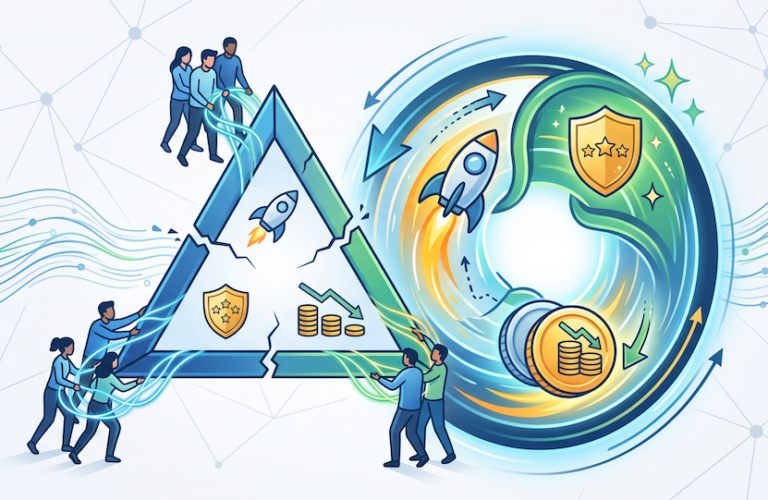
This aligns directly with everything we have shared this year. The iron triangle breaks when validation is built in rather than appended at the end. Trust compounds when quality is proven continuously. And acceleration becomes durable only when validation moves at the speed of creation. These are not separate initiatives; they are one unified discipline.
The organizations that navigate this transition most successfully will not be those that slow AI down, nor those that allow output to bypass validation. They will be the ones that make quality as automated, continuous, and scalable as code generation itself. Speed and trust do not need to be traded against each other. Delivered together, they turn raw velocity into lasting progress.
Building that continuous validation engine alongside your team, and keeping it aligned as AI reshapes modern development, is our commitment to you.
– Kunal
To see how speed, quality, and cost reinforce one another, read our previous post, Breaking the Iron Triangle. If you are ready to make quality move at the speed of AI across your workflows, connect with our team today.

Chief Customer Officer, Applitools
Kunal Rao is a seasoned customer success and go-to-market executive with more than 20 years of global experience building, scaling, and transforming post-sales organizations at technology companies. Read more.