TL;DR
• AI is now foundational to software testing, but more AI often creates more noise.
• AI-assisted development increases code volume and pressure on QA teams.
• The biggest bottleneck in testing today is signal-to-noise, not execution speed.
• Successful testing strategies in 2026 prioritize trust, explainability, and reliable results.
AI has quietly moved from the edges of software testing into the center of it. For most teams, it’s no longer a question of whether AI plays a role in testing, but how deeply—and how intentionally.
Quality and Engineering leaders are feeling this shift firsthand. AI-assisted development is increasing the volume and pace of code changes. Release cycles are accelerating. At the same time, testing teams are being asked to scale confidence without scaling headcount.
In this environment, speed alone is not the differentiator. Trust is.
In AI-driven testing, speed without trust slows teams down.
AI is no longer optional in testing
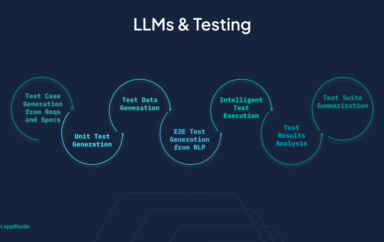
Across the software delivery lifecycle, AI is already embedded in day-to-day workflows. Teams are using it to generate test cases from requirements, assist with automation, create test data, and analyze results. In many organizations, this adoption didn’t start with QA—it started with developers.
What’s changed is that AI is no longer experimental or isolated. It’s shaping how testing actually happens.
This matters because AI-assisted coding changes the scale of the testing problem. More code is being produced, faster than before, and not all of it is high quality. That shift pushes pressure downstream, straight onto QA and QE teams.
More AI hasn’t reduced pressure on QA—it’s increased it
For many Engineering Managers, AI has delivered productivity gains on the development side while increasing complexity on the testing side. Test suites grow larger. Pipelines generate more results. Failures are harder to interpret.
As Applitools CEO Anand Sundaram recently described, the imbalance is real:
“You have more code to be tested, sometimes not the best code, more coverage required, and fewer people.”
– Shaping Your 2026 Testing Strategy
This combination exposes a deeper issue. As tooling improves, teams don’t just get more data, they get more noise. And noise is expensive.
The real bottleneck is signal-to-noise
Most mature teams are no longer blocked by how fast they can run tests. They’re blocked by how confidently they can interpret the results.
As AI accelerates development, signal quality matters more than test volume.
False positives, flaky tests, and inconsistent outcomes force teams into defensive behaviors: re-running pipelines, manually validating changes, and delaying releases “just to be safe.” Over time, automation stops accelerating delivery and starts slowing it down.
This is where many AI-driven testing initiatives struggle. AI can generate more tests and more output, but without reliable signals, that output doesn’t lead to better decisions.
Not all AI is suitable for testing decisions
One clear theme for 2026 is that AI is not a single, interchangeable capability. Different phases of the testing lifecycle have very different requirements.
Large language models excel at tasks that tolerate variation: generating test ideas, creating data, summarizing results, and assisting with analysis. But test execution and release decisions demand consistency, repeatability, and explainability.
This distinction becomes especially clear when you look at test execution. Unlike test generation or analysis, execution depends on consistent behavior and repeatable outcomes.
When test outcomes change run to run, teams lose trust. When failures can’t be reproduced, debugging slows down. And when decisions can’t be explained clearly, confidence erodes—both within engineering and with leadership.
Trust, explainability, and repeatability matter more than novelty
As AI adoption grows, testing teams are being forced to answer harder questions. Can we trust these results? Can we explain them? Can we confidently make release decisions based on them?
These questions matter in regulated and high-risk environments, but they’re just as relevant for any team shipping customer-facing software at speed. Reliability is not a constraint on velocity—it’s what makes velocity sustainable.
Teams operating under stricter compliance requirements have already learned that explainability and repeatability are non-negotiable for AI-driven testing decisions. (Read more—AI Testing in Regulated Environments: Smarter Testing Starts With Stability, Not More Code.)
This is why many teams are rethinking how they apply AI to testing. Deterministic approaches—systems that behave consistently and predictably—make it easier to reduce noise, identify real failures, and move faster with confidence.
What this means for testing strategy in 2026
The takeaway for Quality and Engineering leaders isn’t to slow down AI adoption. It’s to be more intentional about it.
Successful testing strategies in 2026 will share a few characteristics:
- AI is treated as foundational, not experimental
- Different phases of testing use different kinds of AI
- Reliability and explainability are prioritized where decisions are made
- Signal quality and maintenance reduction are explicit goals
Not all AI belongs everywhere. Choosing where reliability matters most is becoming a core leadership responsibility for engineering and quality teams. The biggest risk in AI-driven testing isn’t lack of automation—it’s lack of trust.
Choosing progress over noise
AI is reshaping software testing whether teams are ready or not. The challenge now is judgment. Knowing where AI accelerates quality—and where it quietly undermines it—is what separates teams that scale confidently from those that drown in noise.
The fastest teams aren’t the ones chasing the newest tools. They’re the ones that trust what their tests are telling them.
Watch Shaping Your 2026 Testing Strategy now.
Quick Answers
AI accelerates code changes and test generation, but probabilistic (non-deterministic) systems can introduce inconsistent results, leading to flaky tests and false positives. Teams that make intentional choices about where and how AI is used will scale faster with less noise and higher confidence.
The biggest risk in AI-driven software testing is loss of trust. When test results aren’t repeatable or explainable, teams slow down releases and reintroduce manual validation.
No, not all AI is bad for test automation. AI is highly effective for test generation, data creation, and analysis. Problems arise when probabilistic (non-deterministic) AI is used for execution and decision-making.
Software engineering and QA/QE leaders should prioritize reliable signals, reduced maintenance, and explainable results over raw test volume or novelty.