Give Your Optimizely Devs (and Agents) Visual Guardrails to Prevent Bugs. Save your spot for the Oct. 29th webinar

Give Your Optimizely Devs (and Agents) Visual Guardrails to Prevent Bugs. Save your spot for the Oct. 29th webinar
Optimizely sites are dynamic, UI-heavy, and constantly changing. That's exactly where layout shifts and content defects hide, and exactly where Applitools' Visual AI is built to find them.
The Applitools Visual AI engine reduces false positives and cuts the maintenance load that comes with keeping Playwright scripts alive on a platform where the UI is dynamic, heavy, and always shifting. It catches the layout shifts and content changes that other tools miss.
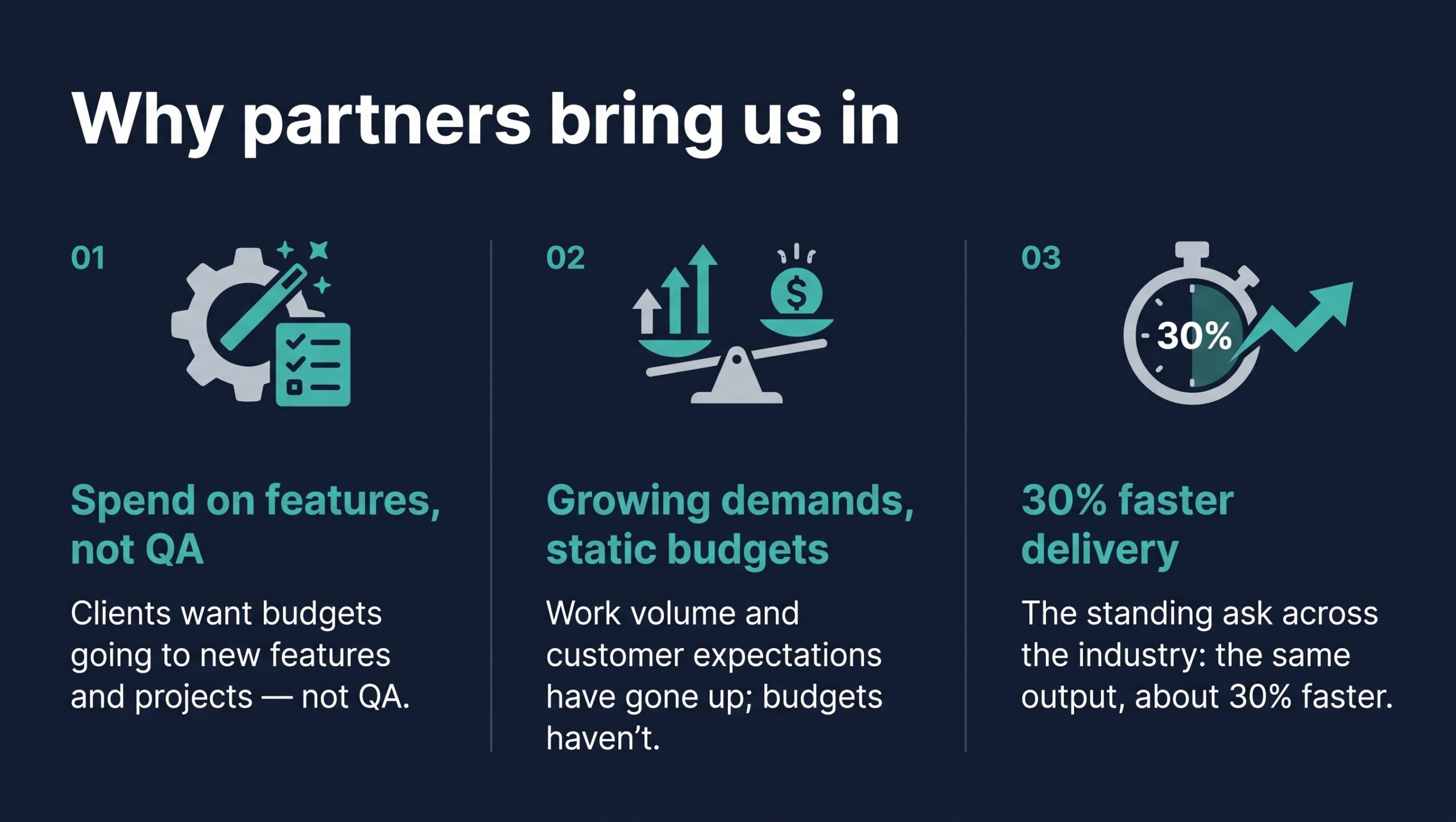
We work with a range of Optimizely customers and partners, from leading retail brands to MarTech organizations. Talking to teams in that space, the pattern repeats: clients want their budget going toward new features, not QA, and the volume of work expected from the same team keeps climbing.
That's where Applitools fits. We take on the burden of Playwright maintenance and noise with our visual AI, and plug into your agentic SDLC through our MCP tools, which give your coding agents "eyes" — so your team spends its time delivering for clients, not validating. If you're still testing manually, we automate the dynamic, rapidly changing pages for you, which speeds up delivery and frees developer bandwidth for the next client project.
coverage increase over manual testing, one test across every screen size and browser
faster delivery is what your clients are already asking for, on the same budget
of visual AI development, trained on 12B+ web pages
A clean baseline, set once, tested everywhere
When you're migrating a project for a client, we set the baseline and test across every browser and device so the migration ships clean — with the accuracy and speed a re-platform actually needs.
Testing 50 components is easy. Testing 1,000 pages built from them isn't.
Fifty to a hundred components are manageable to test on their own. Spread across a thousand pages — where one page has twenty components and another has a single component running the full width of the page — across every screen size, and it stops being something a person can track by hand. Visual AI checks every page, at every screen size, in one run.
Test directly against the design spec
Native Figma design baselines turn your designs into automated visual references. Developers and designers validate builds against the original spec automatically, catching drift before it becomes rework and giving the team one reliable source of truth for implementation.
Replace locators with something that doesn't break
If you're testing Optimizely pages in Playwright today, most of your time goes to maintaining the locators and selectors that identify elements on the page — nearly impossible to keep up with visually heavy and fast-changing sites.
The fallback isn't actually a fallback
Teams often revert to manual testing because keeping Playwright current is too much overhead — but manual testing at this pace isn't manageable either. Validating a week's worth of rapidly changing pages by hand takes hours, and that's against a single browser and device.
Applitools automates that effort and increases coverage 10x with our Ultrafast Grid, which runs one test across every screen size and browser at once.
Every CMS platform, Optimizely included, lives or dies on how fast you can push content changes without breaking the experience. The teams that win validate those changes in minutes, not hours — faster validation means faster releases, faster time to market, and less engineering time spent on QA instead of building.
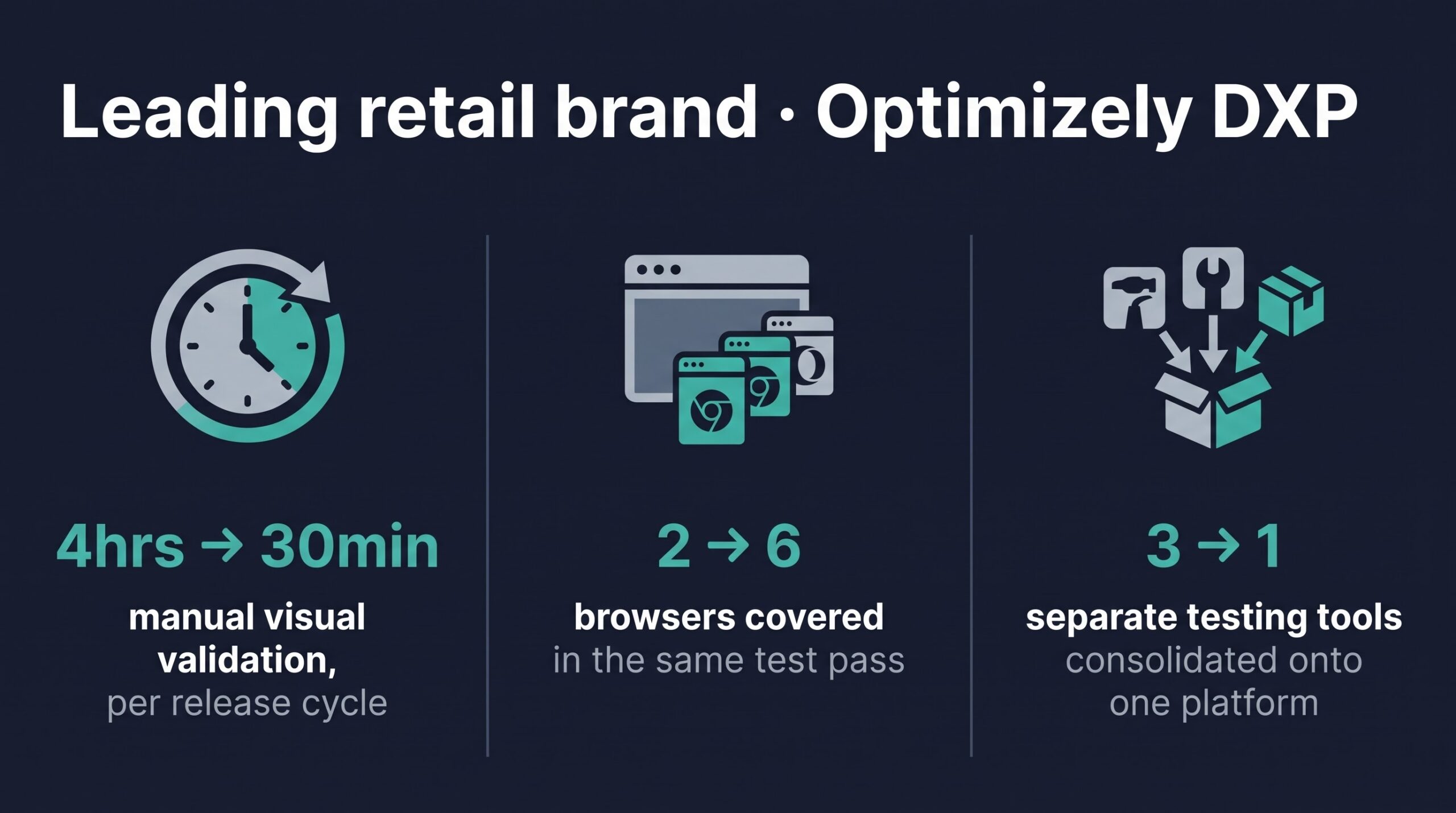
For a leading retail brand using Optimizely DXP, our solution reduced manual visual validation per release cycle from 4 hours down to just 30 minutes, expanded browser coverage in a single test pass from 2 to 6, and consolidated 3 separate testing tools onto 1 unified platform. These strong results led the brand's senior director to sign off and convert the initial pilot into a multi-year deal.
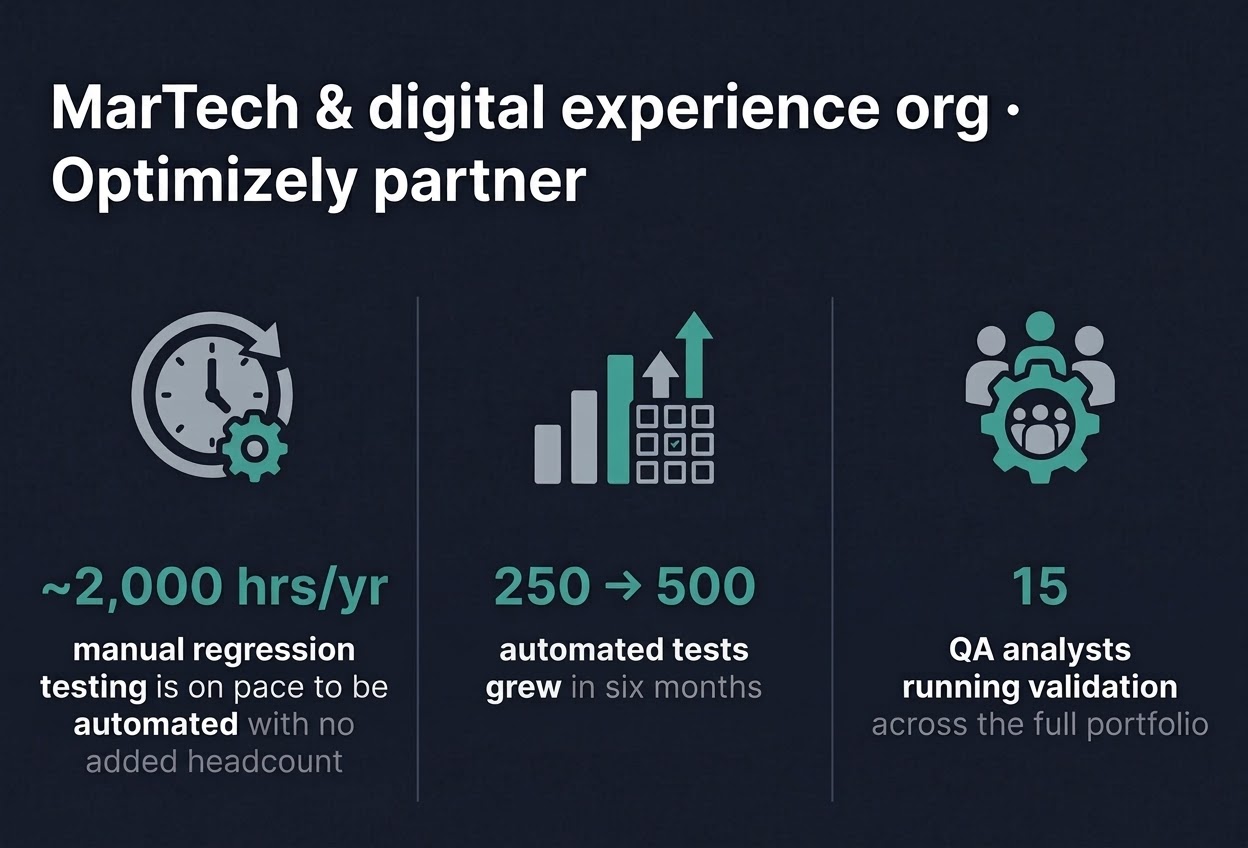
For a MarTech & digital experience organization and Optimizely partner, about 2,000 hours a year of manual regression testing is on pace to be automated with no added headcount. Automated tests grew from 250 to 500 in six months, with 15 QA analysts running validation across the full portfolio. The team moved validation earlier in the build process instead of catching issues after launch, and did it all with the same headcount it started the year with.
As your teams lean further into an agentic SDLC, AI is writing more of the code and more of the tests meant to validate it. Someone still has to confirm that coverage is real, and that confirmation can't be what slows the release back down. Applitools is the deterministic quality gate that lets AI-generated changes ship at speed instead of sitting in manual review.
The same velocity pressure shows up even more acutely once you're managing testing at scale, across many properties, brands, or client campaigns at once. For leadership, it's the same equation as release velocity anywhere else in the org: more output, same team, faster delivery, at a fraction of the labor cost. As AI generates more code and more test scripts through your own pipeline, the risk is spending more engineering time reviewing that output than you saved creating it. Applitools removes that bottleneck so speed and confidence increase together.
